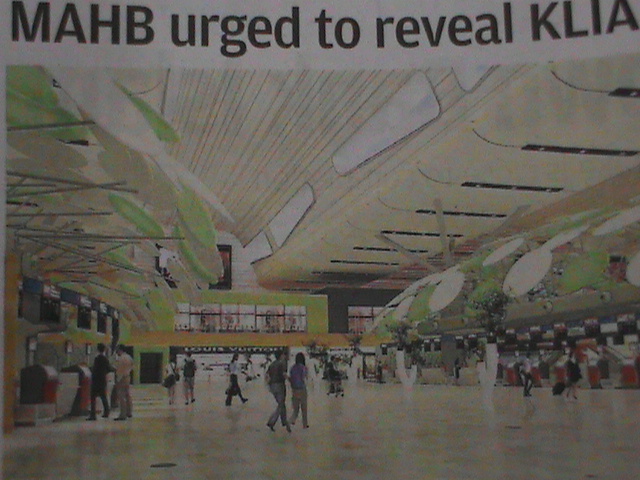
Not many Malaysian are aware that KLIA 2 is delayed for 5 times.
These are the supposely completion dates and the delays. The latest target date is Mar 2 , 2014.
- 1 - first target sept 2011
- 2 - Apr 2012
- 3 - Oct 2012
- 4 - May 2013
- 5 - Jun 2013
- 6 May 2, 2014
Based on the track records, it is doubtful that the new target date of May 2014 will be met.
It was reported that the blame is on MAHB since the project is wholly undertaken by the company. However, a lot of the details may not be revealed to the public. Although it is managed by the MAHB, I doubt that the company is allowed to make the salient decisions. Based on the experiences with MAS, when MAS bought the B747 with different versions of engines, a decision where no airline would have made. Decisions were made at the higher levels and beyond the company. We are not privy to the process of short listing and selection of the main contractor. The contractor UEM is not a stranger to the local scene.
Friday, July 5, 2013
Sunday, June 30, 2013
KLIA2 Delays and The Blaming Game
Fiasco in the KLIA is nothing new. When the airport opened on 27 June 1998 a week before the Hong Kong's opening. The truth was, the airport was not ready. That time I was still working with MAS, and spent weeks in KLIA, doing the volunteer jobs to help ease up the system. The gate allocation system did not work yet. So yo can find pilots were looking around for their aircraft. The airlines staff were having problem to identify which aircraft were for which flight.
The bag tagging and sorting system did not work. The aircraft departs without the bags. You can find thousands of passengers bags laying to be identified.
In most countries that care for safety and passengers comforts, rather that records of achievements, would not open such airport.
AIR ASIA
- Urge the government to set up independent body to probe the delays.
- The airline alleged that the cost could be in term of 5billions.
- Dismissed the claim that the delay due to the airlines slow decision on the baggage handling system.
MALAYSIAN AIRPORTs
- Slapped LAD totaling rm63.42mil
- Cost capped to rm4bil
BINA PURI - Part of UEM Group with possible link to UMNO.
- appealing against the LAD
- Delays were caused by last minutes decision by MAHB
- 93% of the jobs have been completed and the remaining 7% by end of this year.
The bag tagging and sorting system did not work. The aircraft departs without the bags. You can find thousands of passengers bags laying to be identified.
In most countries that care for safety and passengers comforts, rather that records of achievements, would not open such airport.
AIR ASIA
- Urge the government to set up independent body to probe the delays.
- The airline alleged that the cost could be in term of 5billions.
- Dismissed the claim that the delay due to the airlines slow decision on the baggage handling system.
MALAYSIAN AIRPORTs
- Slapped LAD totaling rm63.42mil
- Cost capped to rm4bil
BINA PURI - Part of UEM Group with possible link to UMNO.
- appealing against the LAD
- Delays were caused by last minutes decision by MAHB
- 93% of the jobs have been completed and the remaining 7% by end of this year.
Wednesday, June 26, 2013
KLIA2 - 212 NCR on UEM- Bina Puri
| the star biz 24 Jun 2013 |
For now the UEM Bina Puri has been slapped with RM6mil monthly fine. With the handling over in on Apr 31, the fine will be for 318 days from the original date on Jun 16 2013, and with charges of rm199,445.40, the total fine will be rm63.42mil.
UEM won the contract to build up the KLIA2 for rm997.2 mil in 2010. The new revised budget to complete the airport is RM4billion.
Tuesday, June 25, 2013
Penang Bridge Collapsed on 6 June 2013
Another project by Malaysian Federal Government collapsed just three months before its official opening. A section of the ramp linking it to the expressway collapsed and it was feared that 4 peoples were killed.
The concessionaire, Jambatan Kedua Sdn Bhd said that the collapsed part was being casted at the time, when scaffolding supporting it collapsed.
The 24km long bridge is set to be the longest in SE Asia and the 20th longest in the world scheduled to be completed in July and road tested in Aug and officially opened in Sept 2013.
Tajuddin Zainal Abidin was killed when 500 tonnes of concrete fell into his car.He was burried at Kampong Perlis in Bukut merah. He survived by his wife Sharifah and daughter Nur Aina Syazwani.
| The Star 7 Jun 2013 |
The 24km long bridge is set to be the longest in SE Asia and the 20th longest in the world scheduled to be completed in July and road tested in Aug and officially opened in Sept 2013.
| star 8 jun 2013 |
Thursday, June 13, 2013
Wednesday, April 24, 2013
East Coast Economic
ECER corridor was suppose to be developed for 5 areas...
- tourism
- oil and gas
- manufacturing
- agriculture
- education
This was stated in the forward by Najib..
Foreword by The Prime Minister
- tourism
- oil and gas
- manufacturing
- agriculture
- education
This was stated in the forward by Najib..
Foreword by The Prime Minister
As Chairman of the East Coast Economic Region Development Council (ECERDC), and on behalf of the ECERDC Council Members, I am pleased to highlight the considerable investment opportunities that exist within the East Coast states of Malaysia, as well as the perceptive foresight and strategic planning that goes into making this Region one of the best kept secrets within the business world.
Known collectively today as the East Coast Economic Region (ECER), the states of Kelantan, Terengganu, Pahang and the district of Mersing in Johor has long been a haven for travellers from around the world. We are positioning it as a choice destination for investment, work and living for local and international business communities.
Since its inception in June 2008, ECERDC has been implementing various economic projects through the five economic clusters, namely in Tourism, Oil, Gas & Petrochemical, Manufacturing, Agriculture and Education.
Within the ECER, infrastructure projects have been identified as key components in accelerating Regional economic growth. Improvements in road, air and maritime facilities and networks to enhance connectivity and linkages, as well as improvements in key infrastructure such as electricity, water supply, telecommunications and ICT to meet the current and projected demands are excellent examples of the Government’s commitment to boost infrastructure within ECER.
To further enhance the Region’s competitive advantage, the ECER Special Economic Zone (ECER SEZ) was established in August 2009 as a strategic initiative for a more focused investment approach. The ECER SEZ will act as the national development catalyst for concentrated decentralisation of economic activities in line with the New Economic Model, which aims for a dynamic and competitive Region of growth.
The ECER SEZ is a concentrated area with numerous high-impact projects currently ongoing in the ECER. Supported by customised package of incentives to meet the needs of investors, the ECER SEZ is expected to provide a great impetus for growth and investments within the East Coast Region.
As a whole, ECER is expected to implement projects worth an estimated RM112 billion in value by year 2020. The ECER SEZ specifically is expected to generate up to RM90 billion in investment and contribute RM23 billion to the national GDP, as well as create 220,000 new jobs out of the 560,000 jobs identified under the ECER Master Plan.
To ensure that the Region has the critical mass to achieve economies of scale, several pro-business policies were instituted and modified to offer investors a dynamic and vibrant business environment that is supported by a market-oriented economy.
In addition, the ECERDC’s One Stop Centre was also established to further facilitate the investor’s needs, by providing a single point of contact for prospective investors to receive, process and expedite approvals in the promotion of trade, investment and development on behalf of the state and federal Government entities.
Human resource plays a key role in maintaining a competitive business advantage in any given industry. In ECER, strong emphasis on human capital development ensures a steady supply of skilled and semi skilled manpower to meet the needs of the expanding industrial and services sectors.
Continuous active engagements and promotions to the local and global trade and business fraternities will also be pursued, either by participating in investment missions and trade shows in key investment markets or even industry-related forums, seminars and conferences.
The Region’s distinct culture and heritage is also another of ECER’s greatest assets. Unmatched for its uniqueness, the East Coast’s culture is eloquently expressed in its handicraft, dances and architecture, not to mention the array of foods that blend influences from the East and the West.
Against such a unique backdrop, together with a competitive cost of doing business, stable political environment, increasing per capita income and the potential for regional integration throughout the Asia-Pacific market of 2.2 billion people, ECER is indeed an attractive investment prospect, offering investors a wide spectrum of varying opportunities.
Needless to say, we are truly steadfast in our vision to transform the East Coast Region in becoming a major international and local tourism destination; an exporter of resource-based and manufactured products, a vibrant trading centre and a Regional infrastructure and logistics hub.
With such an impact to the nation’s economy in general, it is imperative that ECER, being a national economic development initiative, continues to move forward with successful implementation. In this regard, I can assure you, the investors and the private sectors within ECER, that the Government is fully committed to the successful implementation of all ECER projects.
As Chairman of ECERDC and on behalf of the ECERDC Council Members, I hereby extend my personal invitation to all would-be investors to come and contribute in transforming this special Region. Let us join hands and work together to realise the vision of ECER to become a developed region by the year 2020.
Dato’ Sri Mohd Najib bin Tun Haji Abdul Razak
Saturday, March 30, 2013
Malaysian Aerospace Centre Since 1993
The talks by politician on the topic of building Malaysian Aerospace centre with acceptable level of credibility has been going on for more than 20 years.
In 1993, the PM then, made an ambitious plan to put Malaysia into Aerospace Manufacturing map, and three projects were launched..
- The Eagle Aircraft Project by Eagle Aircraft (Malaysia) Sdn Berhad. Many are wondering what happen this project. I know a few Eagles were on sale for RM50,000 to training organisations.
- The second project was the German-designed Dornier Seastar CD2, a twin engine forteen seater amphibious aircraft scheduled to be manufactured in 1993.
- The third is the Swiss-designed Datwyler MD3-160. The two-seater aerobatic trainer aircraft by SME Aerospace.
Looking to the south, the neighboring Singapore had made a giant lap, It may be a good idea for the the Minister Mukhriz to
The extract of the speech is given below...
In 1993, the PM then, made an ambitious plan to put Malaysia into Aerospace Manufacturing map, and three projects were launched..
- The Eagle Aircraft Project by Eagle Aircraft (Malaysia) Sdn Berhad. Many are wondering what happen this project. I know a few Eagles were on sale for RM50,000 to training organisations.
- The second project was the German-designed Dornier Seastar CD2, a twin engine forteen seater amphibious aircraft scheduled to be manufactured in 1993.
- The third is the Swiss-designed Datwyler MD3-160. The two-seater aerobatic trainer aircraft by SME Aerospace.
Looking to the south, the neighboring Singapore had made a giant lap, It may be a good idea for the the Minister Mukhriz to
The extract of the speech is given below...
Oleh/By : DATO' SERI DR. MAHATHIR BIN MOHAMAD
Tempat/Venue : LANGKAWI, KEDAH
Tarikh/Date : 07/12/93
Tajuk/Title : THE OPENING OF THE LANGKAWI
INTERNATIONAL MARITIME AND
AEROSPACE EXHIBITION 1993
On behalf of all Malaysians, I wish everyone a warm
'Selamat Datang' to the Islands of Langkawi, the isles of
many legends, and, in particular, to the Langkawi
International Maritime and Aerospace Exhibition (LIMA),
1993. I hope you managed to get a glimpse of our rich
cultural heritage in the welcoming ceremony you just
witnessed. For those who were here for the inaugural
exhibition of LIMA '91, I am sure you will have noticed the
many infrastructural changes which have been made. This is
to ensure that your stay here will be more comfortable.
2. Langkawi is centrally located within the growth
triangle recently formed by the northern states and
provinces of Malaysia and Indonesia, with the southern
provinces of Thailand. With this growth triangle concept,
it is anticipated that the region will gain importance, not
only as an attractive tourist destination, but also as a
vital investment location. An international level
exhibition such as LIMA is both apt and timely. The
Government hopes that more international events will be
staged here in Langkawi, especially at this new
International Exhibition and Convention Centre.
3. Although most of the world saw recessionary trends in
the last few years, the economies of East Asian
nations -- particularly those in Southeast Asia -- continue
to show dynamic growth. Malaysia is at the heart of this
growing region and has developed a strong manufacturing base
during the last five years. The Malaysian economy has moved
away from its traditional reliance on the export of raw
materials to the export of manufactured goods. Malaysia
is also moving away from labour - intensive to capital and
technology-intensive industries.
4. With this solid 'hi-tech' and engineering background,
Malaysia is proud to step into the aerospace industry. When
LIMA '91 was held it stimulated a lot of interest and
awareness among Malaysians and foreign industrialists of the
potential that exists in the aerospace industry, especially
in the Asia Pacific region. This industry is associated
with high technology which we are anxious to acquire in
order to bring the nation to a higher level of technological
advancement and international competitiveness.
5. This time, two years after LIMA '91, a Malaysian
company, Composite Technology Research Malaysia (CTRM),
announced its participation in the production of the Eagle
X-TS, a light all- composite aircraft, in partnership with
an Australian company. As of May 28 this year, Malaysia
took over the whole company. The first production model of
the Eagle rolled out of the Australian facility in Perth
last October. Today, it is being displayed for the first
time in Malaysia. Plans are now in hand to manufacture the
aircraft entirely in Malaysia. The Eagle project is one of
the bold steps that we are taking into the world of
composite technology. Eagle Aircraft (Malaysia) Sdn Berhad
has also secured firm orders for six aircraft from its first
customer, the Conservation and Land Management Authority of
Western Australia. The Eagle is suited for leisure flying
and for surveillance work.
6. This year, Malaysia became involved in two other
aircraft manufacturing projects. I am pleased to announce
that the German-designed Dornier Seastar CD2, a
twin-engined fourteen-seater, amphibious aircraft is
scheduled for manufacture in Penang next year. Aerospace
Industries Malaysia (AIM) is leading a consortium of
companies to produce the Seastar entirely in Malaysia. This
aircraft has enormous scope for sales in the Asia-Pacific
region, being useful both for maritime patrols, search and
rescue missions, as well as for lake and island resorts.
7. A third project is the production of the Swiss-designed
Datwyler MD3-160 two-seater aerobatic trainer aircraft. SME
Aerospace will be producing these low-cost trainers, and we
expect to see the first Malaysian-produced MD3s flying
before the end of next year. There is a demand for this
category of aircraft world-wide and SME Aerospace hopes to
secure a market niche.
8. In manufacturing these three aircraft, we have embarked
on new areas of technology with very stringent quality
requirements. The demands of the aerospace industry also
require that the Malaysian workforce be extremely conscious
of quality in the whole production process. We believe we
have the necessary work ethics and skills for this kind of
industry.
9. These are undoubtedly small beginnings. But then the
U.S. entered the aerospace industry with the Kitty Hawk, an
aircraft that is even more primitive than the three aircraft
I have mentioned. In a century's time we may have our
Boeing and McDonnell Douglas counterpart, God willing. But
a beginning has to be made. And three small aircraft make a
good beginning, modest though they may be.
10. In conjunction with its efforts to promote composite
product manufacturing in Malaysia, the Government has
approved a Composite Manufacturing Zone (CMZ) in Malacca.
The CMZ, among other things, will house:
- an aerospace industries centre, with Eagle Aircraft
Malaysia taking the lead;
- a non-aerospace products manufacturing centre, with
Talon Malaysia as a key tenant manufacturing
hockey sticks from composite materials; and
- an advanced composites laboratory to provide
research backup for companies located in the CMZ.
11. We look forward to having more companies, both local
and foreign, joining us at the CMZ. Composites, as you are
well aware, could be used in the manufacture of many
sporting items, marine vessels, fittings for trains and
vehicles and all containers where payload and strength are
major considerations. Of course more and more composite
materials are being used in both commercial and military
aircraft. Up till now a great deal of manual work is
required. And Malaysia's low-cost highly- skilled workers
are a great asset in manufacturing with composites.
12. Malaysia is also developing its own maritime
industries. We have already built freighters and ferry
boats. The naval dockyard at Lumut, which was corporatised
two years ago, will be a new entrant into the shipbuilding
industry. It will be involved in the construction of patrol
vessels for the Royal Malaysian Navy in collaboration with
foreign shipbuilding companies. Local industries involved
in the manufacture and supply of shipboard equipment and
systems will be able to participate and benefit from the
transfer of its technology. The Ministry of International
Trade and Industry will spearhead a vendor development
programme for small and medium scale industries to support
the patrol vessel project, just as it did for the national
car project.
13. There is also a great deal of potential in the
construction of pleasure craft. During LIMA '91, almost all
the pleasure boats exhibited were sold by the end of the
exhibition. The growing affluence of Malaysia and its
neighbours will undoubtedly create a demand for such craft.
I would like to urge local and foreign entrepreneurs to look
into the possibility of developing Malaysia as the regional
centre for the production of such craft. With more such
craft in local waters there will be increasing needs for
marinas and boat maintenance facilities. Quite a number are
being built now, but I believe more will be needed soon.
14. In order to meet the demands of industrialisation and
new technologies, changes will be made to the education
policy and new courses will be offered by the institutions
of higher learning, government and private sectors.
15. The government spares no effort to provide all the
necessary support facilities to the private sector keen to
invest in high technology ventures. The hi-tech park being
developed in Kulim, Kedah and the CMZ in Malacca are just
two examples of this effort. The Malaysian Government as
you can see responds quickly to the needs of investors.
16. I would like to point out once again that the Langkawi
International Maritime and Aerospace Exhibition is not just
another aerospace or maritime show. It is true that almost
every country in Asia now holds such exhibitions. But LIMA
is still relevant and special because it is held in a region
with the fastest growing economy. People in this region are
now more affluent and are not only travelling more but
are actually beginning to regard ownership of private jets
and luxury boats as essential for business and for pleasure.
17. At LIMA, exhibitors will have the maximum time to
display and demonstrate the capabilities of their products
to the people who matter. The site of this exhibition
permits full aerobatics as we are not hampered by the
operational needs of a busy commercial airport, by
densely-populated population centres or by crowded harbours.
18. LIMA '93 is more than twice as big as LIMA '91, the
first aerospace and maritime exhibition in Langkawi. This
in itself is evidence of its recognition and relevance. But
in addition, the seminars on aviation held in conjunction,
is topical and relevant to the expanding air travel industry
in the region and the world.
19. Besides, Langkawi is a wonderful place for both work
and play. Less than 10 years ago there were only about
30,000 visitors to these islands. Last year more than a
million visitors came, some 30 percent of whom were from
outside Malaysia. So your business visit in 1993 should be
followed by vacations on these islands in the future. You
will find that LIMA has introduced you to more than just an
aerospace or maritime show.
20. The series of LIMA exhibitions that we plan to stage is
also aimed at challenging Malaysians to respond and be
pro-active to the demands of a technology-driven world.
Malaysia cannot afford to be left behind. In a competitive
world there can be no complacency. Alertness and a
willingness to venture into new fields are the prerequisites
of merely staying abreast.
21. I would like to thank all exhibitors and guests who
have come from far and near to support LIMA '93. I am
confident that the business contacts they will make in the
course of their participation in LIMA '93 will be most
worthwhile.
22. It now gives me great pleasure to declare LIMA '93
open.
Wednesday, March 13, 2013
Petronas Project US$2bil
Petronas, the biggest Malaysian Company is about to award a large company under the EPCC concept (engineering, procurement, construction, commission) to a Japanese company. The project is for LNG train at the Complex at Bentulu. Sarawak.It is unknown who the local partner is, and it is hoped that the partner is a company involved with similar activities.According to Upstream report, the Japanese company was responsible for eight trains earlier trains.
In Feb 2013, Petronas awarded Front End Engineering Design project to JGC corporation and Chiyoda Corp.
Search in google shows JGC to be....JGC (Malaysia) Sdn Bhd is a company dealing with oil & gas engineering & construction. It was establised in 1984. It's headoffice JGC Corporation is based in Yokohama, Japan.
Monday, January 14, 2013
EPF project Battersea Power Station
EPF and Sime Darby is launching the controversial UK project to build the Battersea Power Station.
The Malaysian consortium is made up of EPF, SP Setia, Sime Darby tendered and was awarded the contract with the projected value of RM40bil.
The contract include the building of the residential units. The first phase comprises of 800 mixed units of one, two and three bedrooms apartment.
| TheStar 10 Jan 2013 |
The contract include the building of the residential units. The first phase comprises of 800 mixed units of one, two and three bedrooms apartment.
Tuesday, December 4, 2012
RMAF new Helicopter - 12 EC725
Recently, Malaysian RMAF had received 2 of the twelve ordered EC725 helicopter manufactured by French Eurocopter group.
The Brazilian Bought the Helicopter costing RM 84 mil per unit compared to Malaysian buying at RM193 million per unit, as quoted in the star on 4 Dec 2012.It does appear that the Brazil has a better deal as the helicopters will be assembled in the country (http://events.eurocopter.com/en/article/helibras-inaugurates-major-new-brazilian-assembly-facility-ec725ec225-helicopters-itajuba)
It was reported that Thai is buying four of the kind...Chiangrai Times– The Government of Thailand has reportedly ordered four EC725 helicopters for Search and Rescue (SAR) missions. The €100 million deal was announced by Thai deputy prime minister Yutthasak Sasiprapa on 29 August, quoted by the French media.
The value of 100 million Euro is about RM397.258 million. That mean per helicopter is RM 99.3 million, about half of the Malaysian
Quoted Costs
1. Wiki --- USD25 millions--- RM75 million
2.
The Brazilian Bought the Helicopter costing RM 84 mil per unit compared to Malaysian buying at RM193 million per unit, as quoted in the star on 4 Dec 2012.It does appear that the Brazil has a better deal as the helicopters will be assembled in the country (http://events.eurocopter.com/en/article/helibras-inaugurates-major-new-brazilian-assembly-facility-ec725ec225-helicopters-itajuba)
It was reported that Thai is buying four of the kind...Chiangrai Times– The Government of Thailand has reportedly ordered four EC725 helicopters for Search and Rescue (SAR) missions. The €100 million deal was announced by Thai deputy prime minister Yutthasak Sasiprapa on 29 August, quoted by the French media.
The value of 100 million Euro is about RM397.258 million. That mean per helicopter is RM 99.3 million, about half of the Malaysian
Quoted Costs
1. Wiki --- USD25 millions--- RM75 million
2.
Subscribe to:
Posts (Atom)